在AI如海啸般涌来的时候,在2024年五月我也转型成为了一个“AI投资人”。作为一个没有CS背景没有产品背景的新人,这一年用了大量时间在看lecture、读paper、听播客、体验产品和思考。我没有太多深入细节的背景,很多的观点和思考或许都暗含了错误的假设,但我认为只要能启发思考的内容都是好的内容,也希望分享给大家。
作为第一篇公众号文章,记录一下这一年时常思考的主题和问题,欢迎大家交流讨论。之后会在这里分享各种我觉得有价值的问题、我收集的信息和我的思考。
Magic Ink这个公众号名字是从Bret Victor那里偷来的,文字作为思考的媒介很利于我去把思维显化和对其进行操纵,也适合传播。一直以来都希望通过文字将自己的思考呈现出来,作为自己成长的process data,也分享给有缘的读者。但惰性和拖延是我的天敌,三十岁之际终于下定决心逃逸平庸的重力。
【模型和通用agent】
模型公司的主航道是什么?
最近GPT4.5的访谈里面Dan和Sam的对话又提到了2年前Ilya(《An Observation of Generalization》)和Jack Rae(《Compression for AGI》)的lecture中的观点:压缩让unsupervised learning真的抽象出了规律,产生了智能。但问题是预训练模型的尺寸和压缩数据量似乎是在同比例提升,真的有在做更多压缩吗?
理论上来说压缩率并不是在数据和模型尺寸之间做比较,而是在数据和可以从零开始生成模型weights的最小程序,当数据存在于环境中可以学习的时候,理论上存储权重也是不必要的。Dan在访谈中提到,最终压缩得到的其实是学习速率。
预训练在寻找更高学习速率的办法,o1在寻找反思和回溯的实现方式,包括Shunyu Yao的ReAct提到reasoning+action可以泛化到各类问题解决的场景。
按照DIKW的框架来讲,模型的权重里面或许包含了很多的wisdom、认知,但是OpenAI要解决的问题不是认知而是元认知。
所以OpenAI这样的公司主航道是什么,我的答案是在更高的抽象层次上去寻找实现AGI的路径。这样的路径短期内速度很慢但是长期加速度会很快,因为抽象层次更高,会有更强的泛化性,尤其在通用场景下能解决更多的corner case。通用agent公司更多还是在线性地拓展功能和场景,如果模型公司的拐点到来可能会承受很大的压力。
【taste和垂直agent】
大部分应用创业公司的机会在哪里?
最近Sutton和Shunyu的两篇文章都提到,RL的魔力真的显现出来之后,这个时代非常重要的事情是数据的收集与评估,无论是通过self-play还是手工的方式。
RL让generator的能力不断朝verifier靠近,也解锁了更多产品的可能性,因为我们有了全新的infra不需要我们拥有全面的复杂的能力点,模型让我们可以用很低门槛的方式传递我们的taste,但随之而来的竞争也会在taste上体现,在技术的语境下即我们怎样去做evals。
感性地说我觉得接下来是the era of taste。
乔布斯访谈里面提到他找到了全世界范围内在各个细分领域taste最顶尖的一帮人聚集在一起打造一件产品,他也有名言说很多时候用户根本不知道自己想要什么。用户的want或许是用户的need的60分映射,未来会有更多的产品,基于创始人和团队95分的taste和第一性原理的思考,可以把用户的need用95分的产品去满足。
【从0到1的组织】
OpenAI为啥值这么多钱?
我认为是这个从0到1的组织形态以及超高的人才密度,这两者是互相耦合的。
我认为Sam Altman很了不起,主要是因为他作为CEO成功建立了这样的一个从0到1的组织。去年和DeepSeek的朋友交流的时候还请教过他们怎么看待Sam,那个时候完全没意识到DeepSeek也在以类似的组织形态运转,最后产出了非常出色的成果。
为什么建立这样的一个组织很困难,我觉得主要有三点原因:
1.Founder mode。伟大不能被计划,从0到1都是从最一线的员工身上涌现出来的idea(不论研究还是产品),不能规划也无法做预测。对抗这种风险的最佳方式是建立一个组织,把每一个员工都训练成可能涌现出idea的点,依赖整个系统层面出现涌现的可能性而不是少数几个员工单点涌现。作为CEO来讲,需要采用founder mode从一线员工获取信息并做出决策,因为优秀的idea都是涌现出来的。founder mode在硅谷似乎也是传承下来的,从Steve Jobs到Jensen Huang、Elon Musk、Peter Thiel到Brain Chesky到Sam Altman、Dario Amodei,优秀的CEO之间都有着千丝万缕的联系,Brain Chesky也提到过Jony Ive and Hiroki Asia from Apple inspired me to adopt founder mode
。 2.The Stochastic Mindset。红杉最近的一篇blog里提到:The stochastic mindset moves us from having minimal leverage on a task and 100% certainty of its outcome to 100% leverage on a task and far less certainty on the exact manifestation of its outcome
。我们当前绝大多数的组织都没有这样的mindset但这类mindset似乎又是诞生伟大想法的必要条件,历史上我们看到极少数的学术机构、企业和VC似乎拥有这样的稀缺的能力,不过未来或许模型会让更多组织和个人适应这样的思维模式。
3.组织氛围。顶尖人才为什么愿意留下,按需求理论来讲更有可能是追求成长和自我实现,组织或许应该创造一个高标准、多样而深刻的思想氛围,每个人都在朝一个方向奋力奔跑但在不同的跑道上,同向为竞,相向为争。
另外在中国做这件事,支持的资金属性也是一个巨大挑战。
【情感陪伴】
之前看到王宁对李想说做IP就不要做功能,一旦提供功能就不再具备情绪价值。带着这句话我玩了死亡搁浅,游戏里的讲到了主角和在末世里面大家都视为工具的一个婴儿之间产生情感连接的故事。我很受触动的点在于,我们每个人和一个物体之间的链接都有一条通道,我们对它的第一印象就像一个滤波器,会滤除掉很多另外的属性,比如提供情绪价值的人或物就很难提供功能价值给同一个人。当然随着时间延长提供情绪价值的产品也总会有功能价值被感受到,只是对于功能价值维度的竞争来说没有竞争力,所以才说“一旦提供功能就不再具备情绪价值”。
第二件事是当这条通道是单向索取的时候,它其实只是一个产品满足我的表面的需求,比如c.ai类似的实则内容消费。情感陪伴的核心不是它陪我,而是我陪它,需要通道中的情感双向流动。我们付出情感帮助到它时我们会发自内心的快乐,这可能是人这种社会动物天生的一种自我实现方式,是一种内在的需求被满足。从这个角度讲,能够承载我们付出的情感并给予适当反馈我觉得才是陪伴的核心,才是区别心理咨询师和闺蜜的点。
【内容平台】
内容赛道里面新的生产关系如何构建?
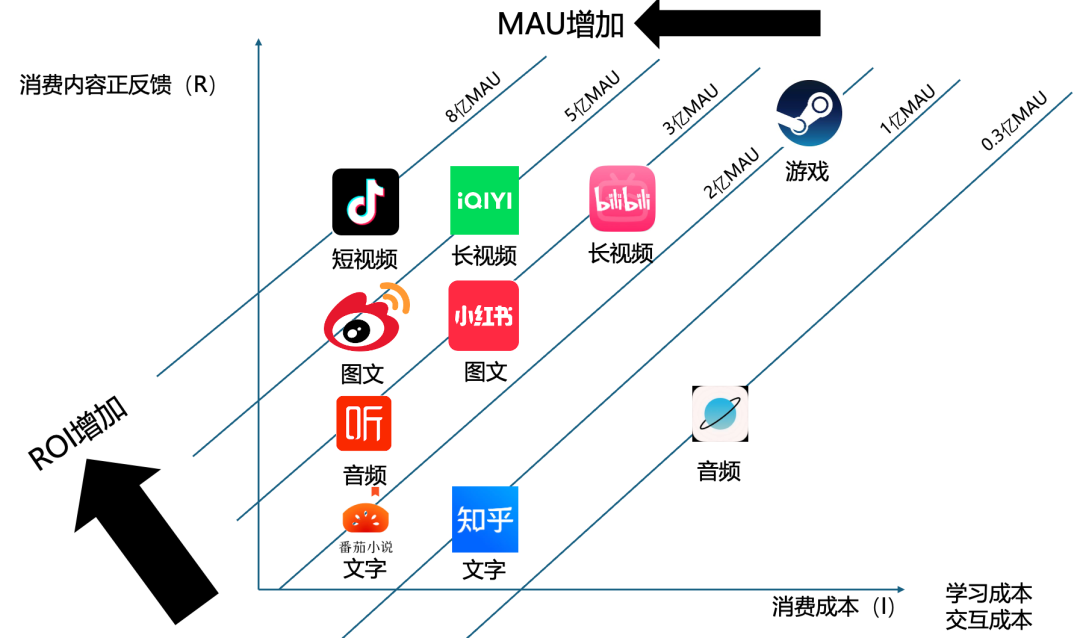
大家比较有共识的是实时生成的内容形态,可以叫交互式视频或者游戏,这都是在消费获得的反馈R上。非共识的是,交互的成本I或许会是决定用户量级的关键,如果要超越短视频,我认为需要接近短视频的交互成本。内容形态和交互体验上的创新或许会产生新的生产关系。
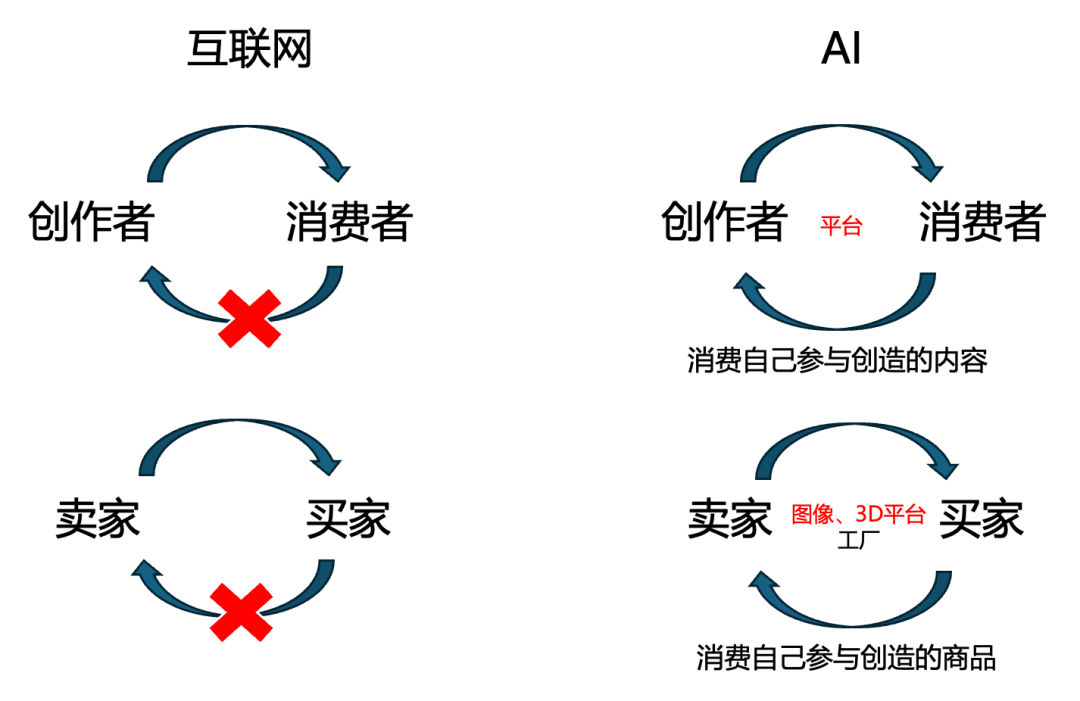
同样的思路,未来的商品或许也会产生新的生产关系。
【HCI】
现在的交互界面大家都发现回到了命令行时代,所以不妨带入乔布斯在Xerox Parc看到GUI的时候,他在思考什么事情?
GUI我觉得区别于LUI最核心的特点有两个:
1.人是视觉动物,大脑接收图像信息的带宽更高,因为大脑的并行构造我们可以瞬间捕捉图像中的颜色、结构、位置关系,但是语言需要时序地处理;
2.语言是离散的,而图形界面是连续的。
所以未来的交互界面我认为应该也是GUI,但是是AI增强的GUI。一方面在需求解决中可以实时生成定制的交互界面,这方面可以参考UCSD Haijun Xia老师的相关研究。另外一方面在创意表达上,连续的界面相比离散语言给了我们更多的探索空间,我们可以通过模型为媒介在向量空间中自由组合延伸,实现更加多样的创意表达;同时通过模型可解释性的研究或许也能加深我们对艺术的理解,这方面可以参考Linus Lee的blog。
【vibe coding】
我的思考中内容消费和软件消费最大的区别在于,内容满足的是对未知世界的体验,所以对内容的需求几乎是在一个无限的虚拟空间里可以任意延伸的,而软件满足的是当下的需求,当下的需求受我们的物理世界约束。
所以未来到底有多少新需求,即便是长尾的,需要新增的软件来解决我没有想得特别清楚。
另外过去软件公司针对长尾需求的ROI过低问题现在同样有AI帮助解决后,这类vibe coding软件的价值有多少我也存疑。
【生命意义的infra】
这个时代的智能成本越来越低,作为人在经济价值中的比较优势越来越低,短期内我们可以寻找新经济结构中的比较优势,但趋势还是会迫使越来越多人思考生命意义和自己的使命。
生命意义或者塑造我们是谁的并不是单一的维度,每个人对各个维度权重也不一样,在我看来向内是每个人生命过程中的每一次思考和决策、每一份生命情感的感受和抒发,向外是和其他人建立的链接与利他。
之前看张小龙说微信最大的意义在于这个ID很受启发,我的想法是人可以有很多的虚拟世界ID,但真实世界只有1个ID。随着真实世界的的数字化进程,真实世界的ID需要一个唯一的数字世界的映射,微信承接了这个数字世界的唯一ID的角色,是因为社交关系某种程度上定义了我们每个人在真实世界中是谁。 微信是向外链接维度的生命意义的infra,猜想还会有更多的软件会成为其他维度的生命意义的infra,也许是记录我们的思考、情绪?
【这个时代对个体最重要的东西】
每天的生活中交织的是情绪和认知,在我的思维里东西方哲学希望我们能习得的是对情绪的情绪和对认知的认知,也是这个时代最重要的东西。
对情绪的情绪:平常心。
对认知的认知:成熟的心智模式,放下ego和偏见,反思。
对群体来讲,最重要的是同理心,以上所有或许也是这个时代最有意义的教育。
【本分与平常心】
我自己理解的本分是长期主义和知行合一,平常心是一种强大的心力,不以物喜不以己悲。
大家都知道是好东西,问题是如何能够获取?
本分和平常心都是中国哲学的体现,中国哲学是人生的哲学,需要的是足够的经历和反思。对于本分,应该要思考的是你有没有找到自己的人生使命,人生使命可能没有来由,甚至我最相信的说法是来自上辈子积累的业力,但找到自己的使命很重要,指引我们的长期方向。
对于平常心,我自己经过人生大起大落会更有感触,以往很多所谓“错误的决策”、“浪费的时间”、“痛苦的情绪”反而让我收获了意外的认知,塑造了我现在的样子,我也很满意现在自己的状态。所以我坚信connecting the dots,只要自己目标坚定,现在的遇到的困难挑战甚至人生低谷都会过去,这段时间的经验也注定会成为你上升时期的燃料。反者道之动,弱者道之用。就像经历过经济周期后的人在下一个经济周期来临时会更加平静,经历过人生的周期后对于下一个人生周期的高峰和低谷也会产生平常心。
【成长】
成长可以给我带来很多好东西,对世界的认知、taste,对生命情感的体验,以及再下一层对认知的认知、对情感的情感等等。
一年前我认为成长本身就是目的而且是人生最重要的意义之一,但现在越来越认为把我在成长中收获到的好东西反馈给这个世界才是成长的目的。原因有两个:
1.引用乔布斯的话,我们享用着别人种的食物,织的衣服,发明的产品,创造的知识,几乎没有一件是我们带给世界的,我们理所应当反馈给世界一些东西;
2.人类就是互相链接着的一张大网,我真切觉得推动人类不断朝更好的世界前行的动力是一些好东西在网络中的流动,可以是知识,也可以是情感,这些好东西既让我们进步,也让我们链接更紧密。
每个人都可以在影响圈内把自己从成长中学到的感受到的好东西传递给他人,只是投资和创业可以以公司为杠杆有一个非常巨大的影响圈,这种巨大的影响力既是能力,也是责任,也要求投资人和创业者的发心得善。
【VC投资】
时常都会问自己的三个问题是:喜欢做VC投资吗?如果现在让你财富自由你愿意继续做吗?如果今天是最后一天愿意做吗?
到现在为止VC投资对自己确实是实现人生意义最好的选择,原因有两个:
1.这个世界还是有太多可以变得更好的地方,投资人可以有更多的选择;
2.作为一个一星的投资人,我可以去支持五星的创业者完成共同的梦想,但自己去创业可能只能做一个一星的创业者对世界的影响小很多。
我最羡慕的是Sam Altman和Daniel Gross的成长路径,作为五星投资人找到了自己愿意all in的方向,成为五星创业者全力以赴。希望未来某一天当自己找到自己的人生使命后,也能拥有从零出发的心力。
最近看到的一句特别喜欢的话作为结尾:
只要拥有重新开始的勇气,青春就没有结束。
As AI came rushing in like a tsunami, I, too, became an “AI investor” in May 2024. As a newcomer with no background in computer science or product, I have spent much of the past year watching lectures, reading papers, listening to podcasts, trying products, and thinking. I lack the background to go very deep into many technical details, and many of my views and thoughts may contain mistaken assumptions. But I believe that anything that sparks thought is worth reading, and I hope to share some of it with you.
For this first post on my WeChat public account, I want to record the themes and questions I have often thought about over the past year. I welcome discussion. Going forward, I will share questions I find valuable, information I have collected, and my own thinking here.
I stole the name Magic Ink from Bret Victor. Writing is a medium that helps me make my thinking visible and work with it, and it is also easy to share. I have long wanted to put my thoughts into words, both as process data for my own growth and to share with readers who happen to find them. But inertia and procrastination are my natural enemies. As I turn thirty, I have finally decided to escape the gravity of mediocrity.
Models and General-Purpose Agents
What is the main strategic direction for model companies?
In a recent interview about GPT-4.5, Dan and Sam returned to an idea from lectures given two years ago by Ilya (“An Observation of Generalization”) and Jack Rae (“Compression for AGI”): compression enables unsupervised learning to truly abstract patterns and produce intelligence. But pretrained model sizes and the amount of data they compress seem to be growing in proportion. Are they really doing more compression?
In theory, the compression ratio is not a comparison between the data and the model’s size, but between the data and the smallest program that can generate the model’s weights from scratch. When the data is available in the environment to learn from, even storing the weights is theoretically unnecessary. As Dan mentioned in the interview, what we ultimately arrive at through compression is, in fact, a learning rate.
Pretraining is searching for ways to achieve a higher learning rate; o1 is searching for ways to implement reflection and backtracking. Shunyu Yao’s ReAct, too, points to reasoning plus action as something that can generalize across many kinds of problem-solving situations.
In the DIKW framework, a model’s weights may contain a great deal of wisdom and cognition. But the problem OpenAI is trying to solve is metacognition, rather than cognition.
So what is the main strategic direction for a company like OpenAI? My answer is to look for a path to AGI at a higher level of abstraction. Such a path is slow in the short term but will accelerate rapidly in the long term. A higher level of abstraction means stronger generalization, especially the ability to handle more corner cases in general-purpose settings. General-purpose agent companies are still largely expanding their features and use cases in a linear way. If the model companies reach an inflection point, those agent companies could face considerable pressure.
Taste and Vertical Agents
Where do the opportunities lie for most application startups?
Two recent essays by Sutton and Shunyu both mention that once the magic of RL really starts to show, collecting and evaluating data becomes one of the most important things to do in this era, whether through self-play or by hand.
RL brings the generator’s abilities closer and closer to those of the verifier. It also opens up more possibilities for products, because we now have entirely new infrastructure that does not require us to possess a full, complex set of capabilities ourselves. Models let us convey our taste with a very low barrier to entry. But the competition that follows will also be about taste—or, in technical terms, how we do evals.
My intuition is that what comes next is the era of taste.
In an interview, Steve Jobs spoke about bringing together people with the best taste in the world in their respective specialties to build a product. He also famously said that users often do not know what they want. A user’s stated wants may be only a 60-out-of-100 reflection of their needs. In the future, there will be more products that can meet those needs at a 95-out-of-100 level, drawing on the founders’ and teams’ 95-out-of-100 taste and first-principles thinking.
Organizations That Go from Zero to One
Why is OpenAI worth so much?
I think it comes down to its organizational form, built for going from zero to one, and its extraordinarily high talent density. The two are intertwined.
I think Sam Altman is remarkable, chiefly because he has succeeded in building this kind of organization as CEO. When I spoke with friends at DeepSeek last year, I asked them what they thought of Sam. At the time, I had no idea that DeepSeek was operating with a similar organizational form, one that would eventually produce outstanding results.
Why is it so difficult to build an organization like this? I see three main reasons:
1. Founder mode. Greatness cannot be planned. Ideas that take us from zero to one emerge from employees on the front lines, in research and in product alike. They cannot be planned or predicted. The best way to contend with this risk is to build an organization that develops every employee into a potential source of emerging ideas, relying on the possibility of emergence across the whole system rather than on isolated breakthroughs from a handful of people. As a CEO, you need founder mode to obtain information directly from front-line employees and make decisions, because great ideas emerge from that work. Founder mode also seems to have been passed down through Silicon Valley: from Steve Jobs to Jensen Huang, Elon Musk, and Peter Thiel, then to Brian Chesky, Sam Altman, and Dario Amodei. There are countless connections among great CEOs. Brian Chesky has also said, “Jony Ive and Hiroki Asia from Apple inspired me to adopt founder mode.”
2. The Stochastic Mindset. A recent Sequoia blog post said: “The stochastic mindset moves us from having minimal leverage on a task and 100% certainty of its outcome to 100% leverage on a task and far less certainty on the exact manifestation of its outcome.” The vast majority of our organizations do not have this mindset today, yet it seems to be a prerequisite for great ideas to emerge. Historically, only a very small number of academic institutions, companies, and VC firms seem to have possessed this rare ability. In the future, though, models may help more organizations and individuals adapt to this way of thinking.
3. Organizational atmosphere. Why would top talent choose to stay? Viewed through theories of human needs, they are more likely to be seeking growth and self-actualization. Perhaps an organization should create an intellectual atmosphere with high standards, diverse perspectives, and depth, where everyone runs hard in the same direction but in different lanes. Running in the same direction is healthy competition; running head-on into one another is conflict.
In China, the nature of the capital backing such an organization is another enormous challenge.
Emotional Companionship
I once saw Wang Ning tell Li Xiang that if you are building a character or an IP, you should not add functional utility: once it provides a function, it loses its emotional value. I had this in mind while playing Death Stranding. The game tells the story of an emotional bond between the protagonist and a baby whom everyone in its post-apocalyptic world treats as a tool. What moved me was the idea that each of us has a channel connecting us to an object. Our first impression acts like a filter, screening out many of its other attributes. A person or object that offers emotional value, for example, may find it hard to offer functional value to that same person. Of course, over time, people will also perceive functional value in products that offer emotional value. It simply will not be competitive on that dimension. Hence the claim that “once it provides a function, it loses its emotional value.”
The second point is that when this channel is only about taking, it is really just a product meeting my surface-level needs—something like c.ai is, in practice, content consumption. At the heart of emotional companionship is not that it keeps me company, but that I keep it company. Emotion needs to flow in both directions through the channel. When we give emotionally and help the other, we feel a joy that comes from within. This may be an innate form of self-actualization for humans as social animals: an internal need being met. From this perspective, I think the core of companionship is being able to receive the emotions we give and respond appropriately. That is what distinguishes a close friend from a therapist.
Content Platforms
How will new relationships of production be built in the content space?
There is broad agreement around content generated in real time, whether we call it interactive video or games. All of that concerns the reward, R, that people get from consuming it. The less widely shared view is that the cost of interaction, I, may be the key determinant of audience scale. To surpass short-form video, I think that cost needs to approach the cost of interacting with short-form video. Innovation in content formats and interaction experiences may give rise to new relationships of production.
Following the same logic, goods may also develop new relationships of production in the future.
HCI
We have all noticed that today’s interfaces have taken us back to the command-line era. So it is worth putting ourselves in Steve Jobs’s shoes when he saw the GUI at Xerox PARC: what was he thinking about?
I think there are two core differences between a GUI and a language user interface, or LUI:
- Humans are visual creatures, and the brain has greater bandwidth for receiving images. Thanks to its parallel architecture, we can instantly register colors, structures, and spatial relationships in an image, whereas language must be processed sequentially.
- Language is discrete; graphical interfaces are continuous.
So I believe the interface of the future should also be a GUI, enhanced by AI. On one hand, it could generate customized interfaces in real time to address our needs; Haijun Xia’s research at UC San Diego is worth looking at here. On the other, for creative expression, continuous interfaces give us more room to explore than discrete language. With models as a medium, we can freely combine and extend ideas in vector space, enabling more diverse creative expression. Research into model interpretability may also deepen our understanding of art; Linus Lee’s blog is a useful reference on this.
Vibe Coding
To my mind, the biggest difference between consuming content and consuming software is that content lets us experience unknown worlds. Demand for content can therefore extend almost endlessly through a boundless virtual space. Software, by contrast, meets needs we have here and now, and those needs are constrained by the physical world.
So I have not fully worked out how many new needs there will be in the future—even long-tail ones—that require new software to address them.
And now that AI can also help existing software companies solve the problem of low ROI in serving long-tail needs, I am unsure how much value these kinds of vibe-coded software will have.
Infrastructure for Meaning in Life
In this era, the cost of intelligence keeps falling, as does our comparative advantage as humans in creating economic value. In the short term, we can look for comparative advantages in the new economic structure. But this trend will still force more and more people to think about the meaning of life and their own mission.
The meaning of life, or what shapes who we are, has more than one dimension, and each person assigns different weights to them. To me, the inward dimension consists of every thought and decision we make throughout our lives, and every feeling we experience and express. The outward dimension consists of our connections with others and acts of altruism.
I was inspired by something Allen Zhang said: that WeChat’s greatest significance lies in the ID it gives you. My thought is that a person can have many IDs in virtual worlds, but only one identity in the real world. As the real world becomes digitized, that identity needs a unique counterpart in the digital world. WeChat has taken on the role of that unique digital ID because our social relationships, to some extent, define who each of us is in the real world. WeChat is infrastructure for meaning in life along the outward dimension of connection. I suspect more software will become infrastructure for other dimensions of meaning in life—perhaps by recording our thoughts and emotions?
What Matters Most to Individuals in This Era
Emotions and cognition are woven through our everyday lives. In my understanding, what Eastern and Western philosophy hope we can acquire is an emotional stance toward our emotions and an understanding of our own cognition. These are also what matter most in this era.
An emotional stance toward our emotions: equanimity.
An understanding of our own cognition: mature mental models, letting go of ego and bias, and reflection.
For groups, what matters most is empathy. All of the above may also be the most meaningful education of our time.
Benfen and Equanimity
My understanding of benfen—doing what is yours to do—is long-term thinking and unity between knowing and doing. Equanimity is a powerful inner strength: not being elated by external gains or saddened by personal losses.
Everyone knows these are good things. The question is: how do we acquire them?
Benfen and equanimity both express Chinese philosophy, a philosophy of life that requires enough lived experience and reflection. For benfen, the question to consider is whether you have found your mission in life. That mission may have no apparent origin; the explanation I find most convincing is even that it comes from karma accumulated in a previous life. But finding your mission matters: it guides your direction over the long term.
As for equanimity, having experienced significant highs and lows in life has made it more tangible to me. Many things I once called “wrong decisions,” “wasted time,” or “painful emotions” instead brought unexpected insights and shaped who I am today—and I am happy with who I am now. So I firmly believe in connecting the dots. As long as you remain committed to your goal, the difficulties, challenges, and even low points you face today will pass. The experience of this period will, in time, become fuel for your next ascent. “Reversal is the movement of the Dao; weakness is its way of working.” Just as someone who has lived through an economic cycle can be calmer when the next one arrives, having lived through a cycle of life can bring equanimity toward the peaks and troughs of the next.
Growth
Growth brings me many good things: an understanding of the world, taste, the experience of life’s emotions, and, one level deeper, an understanding of my own cognition, an emotional stance toward my emotions, and so on.
A year ago, I thought growth was an end in itself and one of the most important sources of meaning in life. Now, I increasingly believe that its purpose is to give back to the world the good things I have gained through growing. There are two reasons:
- To borrow from Steve Jobs, we eat food grown by others, wear clothes woven by others, and use products invented and knowledge created by others. Almost none of these things are what we ourselves have brought into the world. It is only right that we give something back.
- Humanity is one vast, interconnected web. I truly feel that what keeps moving us toward a better world is the flow of good things through that network, whether knowledge or emotion. These things help us progress and bring us closer together.
Everyone can pass on the good things they have learned and felt through growth to others within their circle of influence. Investing and entrepreneurship simply let us use companies as leverage to create a much larger circle. That immense influence is both a capability and a responsibility. It also asks that investors and founders begin from good intentions.
Venture Capital Investing
I often ask myself three questions: Do I enjoy VC investing? If I were financially free right now, would I keep doing it? If today were my last day, would I want to spend it doing this?
So far, VC investing really is my best choice for realizing meaning in my life, for two reasons:
- There is still so much in the world that could be better, and investors have more options to choose from.
- As a one-star investor, I can support five-star founders in realizing a shared dream. If I started a company myself, I might only be a one-star founder and have far less impact on the world.
The paths I envy most are Sam Altman’s and Daniel Gross’s: as five-star investors, they found something they were willing to go all in on, and committed themselves completely as five-star founders. I hope that one day, when I find my own mission in life, I too will have the inner strength to start from zero.
I will end with a line I recently came across and especially liked:
As long as you have the courage to begin again, your youth is not over.